
UX Research Project
Can people who already speak multiple languages learn new ones faster by using what they already know?
Project Objectives
A UX case study on optimizing language learning for multilinguals by adapting to their prior knowledge and minimizing unnecessary repetition.
My Role
Research
UX Design
Tools
Duration
Ongoing passion project
01 Reasons
Basics Are Not for Everyone
Moving to a new country and meeting dozens multilingual immigrants and language enthusiasts as myself, I quickly realized a common struggle.
For those of us who already speak multiple languages, learning a new one isn’t about “where to start?”, but about how to learn efficiently.
Advanced programs and tutors demand time and money, while flexible apps still trap us in repetition.
And let’s be honest – repeating the same basics is just exhausting.
Most popular apps like Duolingo and Babbel are designed for beginners, without considering the user’s prior language knowledge. As a result, even experienced learners end up stuck on exercises that don’t bring real value.
This led me to ask myself:
02 Challenges
Language Apps Fail Multilinguals
Most apps force redundant repetition. Multilinguals need the one which adapts to their experience, highlighting key connections.
03 Understanding Users
The Who
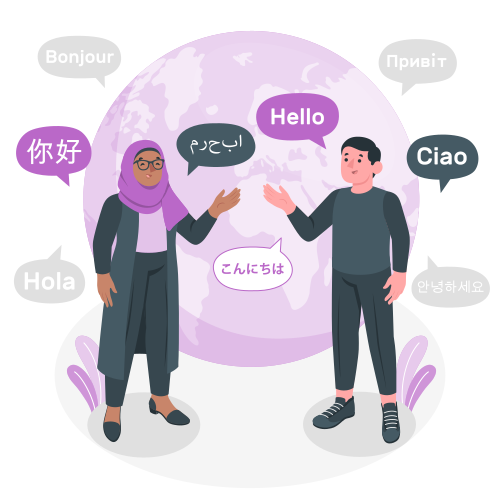
Before designing a smarter approach, I took a deep dive into the struggles of different types of language learners. While they all face common challenges, their backgrounds and needs shape how they approach language learning — and where they run into roadblocks.
Multilingual Immigrants & Expats
For many immigrants and expats, learning the local language isn’t about starting from zero — it’s about quickly picking up the specific structures and vocabulary they actually need. They already have experience learning languages, but group courses move at the pace of the slowest learners, and private tutors require both money and time. The result? Many end up patching together resources on their own.
I can pick up basic vocabulary fast, that’s not the problem. But I wish courses helped me bridge the gaps between what I already know and what’s actually different — so I don’t have to spend hours researching things on my own.
Anna, 34, refugee in Norway
Expat & Multilingual Kids
Children growing up in multilingual households often juggle several languages at once. Most schools and language courses don’t account for this, treating every learner as if they are starting from scratch. Instead of reinforcing the connections between their languages, kids are often left to figure it out themselves, leading to confusion and gaps in their learning.
At home, we speak Ukrainian. At school, I speak German. But I also need to learn English and Spanish. Everything is mixed up in my head!
Ivan, 15, expat kid in Germany
Language Enthusiasts & Polyglots
Many polyglots and experienced learners instinctively compare languages, but apps don’t help them do this. Instead of showing how French and Spanish grammar relate, or how Ukrainian and Polish share vocabulary, they treat every new language as a completely separate system.
I already see patterns between languages I know, but no app actually helps me use that to my advantage.
Tamas, 21, linguistics student
Neurodivergent Learners
People with ADHD, dyslexia, and other neurodivergent traits often struggle with traditional learning methods. Many language apps rely on repetitive drills, which can either be helpful or incredibly frustrating, depending on how the brain processes information. The challenge isn’t just motivation — it’s finding a system that adapts to how they actually learn, instead of forcing them into a rigid, one-size-fits-all structure.
Most apps rely on repetition, but I need a system that lets me jump between lessons and learn in a more dynamic way.
Maya, 30, ADHD learner
04 Existing Solutions
The What
Also I needed to analyze the current landscape of language learning tools. What options do multilinguals and experienced learners have today, and why do these solutions fall short?
Learning Apps
Great for beginner level, but do not recognise prior experience, slows down advanced learners.
Self-Study
Learners choose their own pace, but finding structured material takes effort, lacks clear progression.
Group Lessons
Great for consistency but group follow the slowest learner, give little flexibility for multilinguals.
Private Tutors
Adapt to the student’s needs but require strict scheduling, are time-consuming and expensive.
05 Market Analysis
Positioning
While the niche of multilingual learners remains underserved, I consider it essential to analyze potential competitors of the app — let’s call it LingWeave — as well as explore the monetization strategies used in the language learning market.
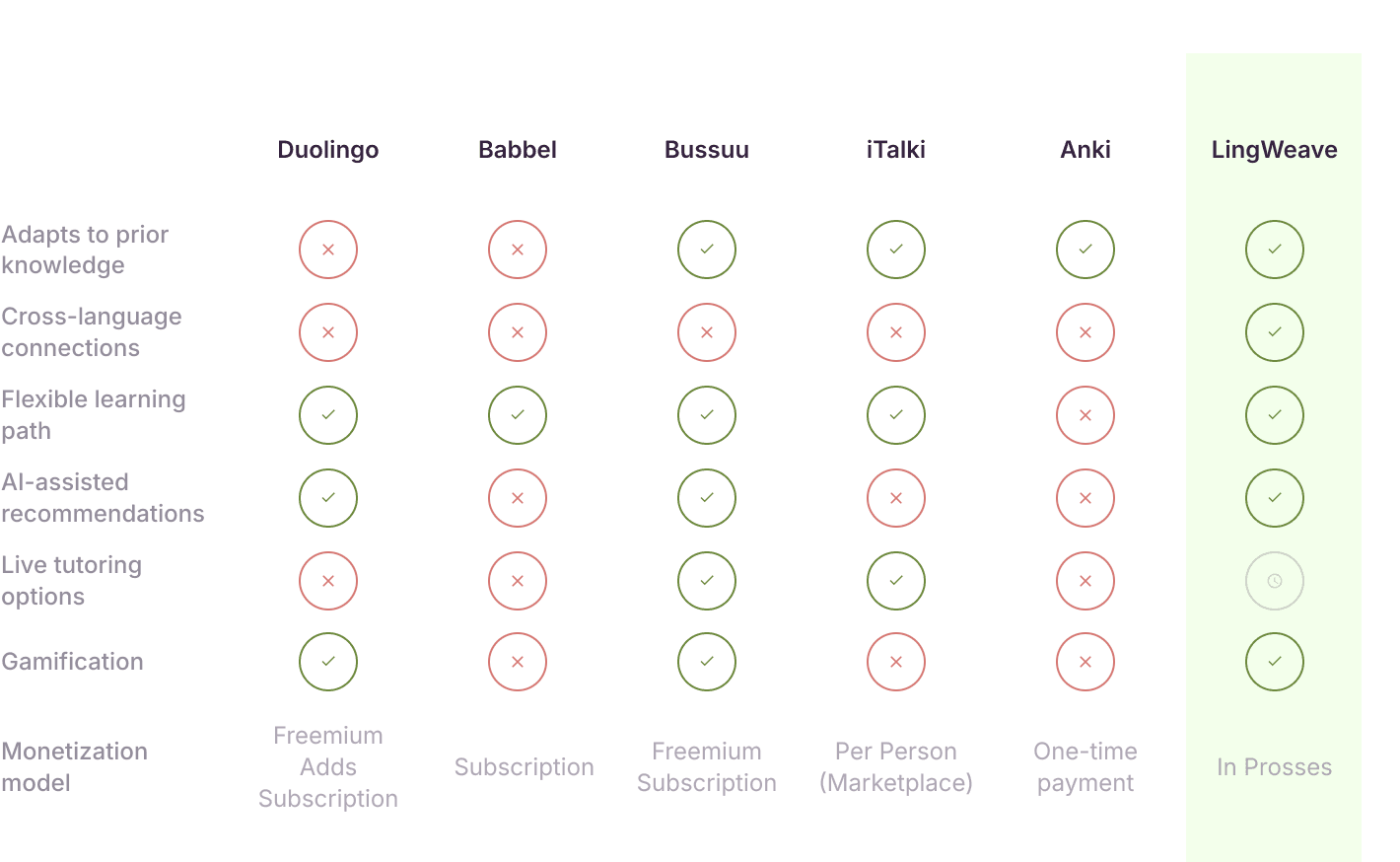
This analysis highlights key gaps in the current market—especially for multilingual learners. With this in mind, the next step is to explore how LingWeave can bridge these gaps and create a more personalized, efficient language learning experience.
06 Key Design Decision
Onboarding Flow
The onboarding was the hardest part to get right — and it went through three major iterations before reaching a version I was satisfied with.
Wrong order
My first logic: choose what you want to learn, then add what you already know. It seemed intuitive — but it immediately created two problems. How do you prevent users from selecting a language they already speak as a "learning" language? What if they pick the same language in both fields?
Solution: Reverse the order. Known languages first, target languages second. The system can then filter suggestions based on what's already selected.
Too many steps
After fixing the order, a new problem appeared. The flow became: select known languages → set proficiency for each → then add target languages. Logical on paper, exhausting in practice — especially for our users who speak 3-4 languages.
Solution: Combine language selection and proficiency level into one step. But this created clutter when multiple languages were selected simultaneously.
Progress bar vs buttons
I tried a CEFR progress bar (A1→C2) for proficiency levels. It looked clean but tested poorly — too small on screen, unfamiliar to users who don't know the European framework.
Solution: Replace with simple buttons per level. Easier to read, easier to tap, works regardless of how many languages are selected. After selecting a level, only the chosen option stays visible with a checkmark — plus a "Change your level" link for quick edits without cluttering the screen.
Where it landed
A hybrid onboarding that feels like a conversation rather than a form. The user declares what they know, the system proposes what makes sense to learn next, and the whole setup takes under 60 seconds.
Final Flow
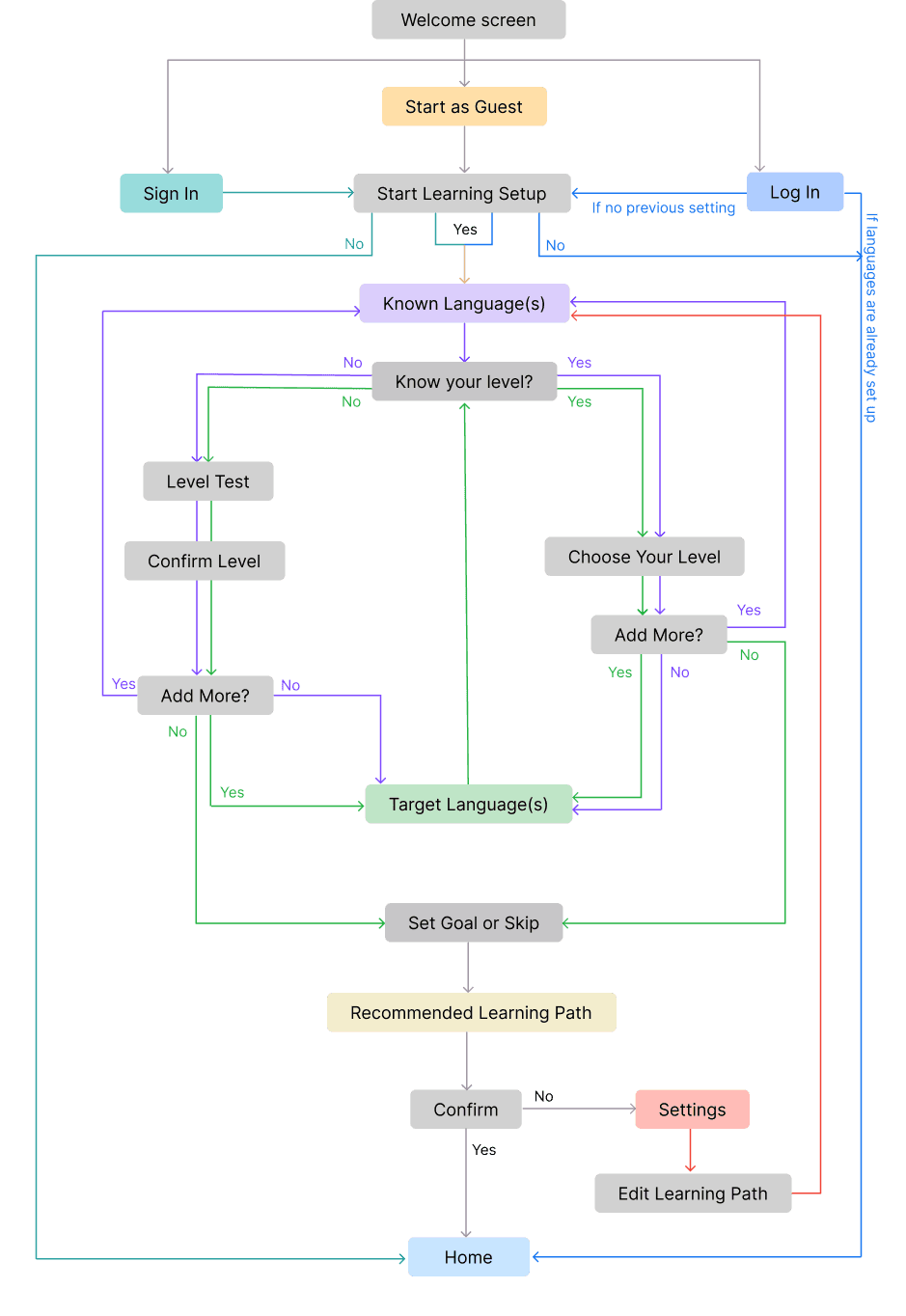
Refined user flow after multiple iterations adapting to the complexity of multilingual experience.
06 Results
MVP Walkthrough
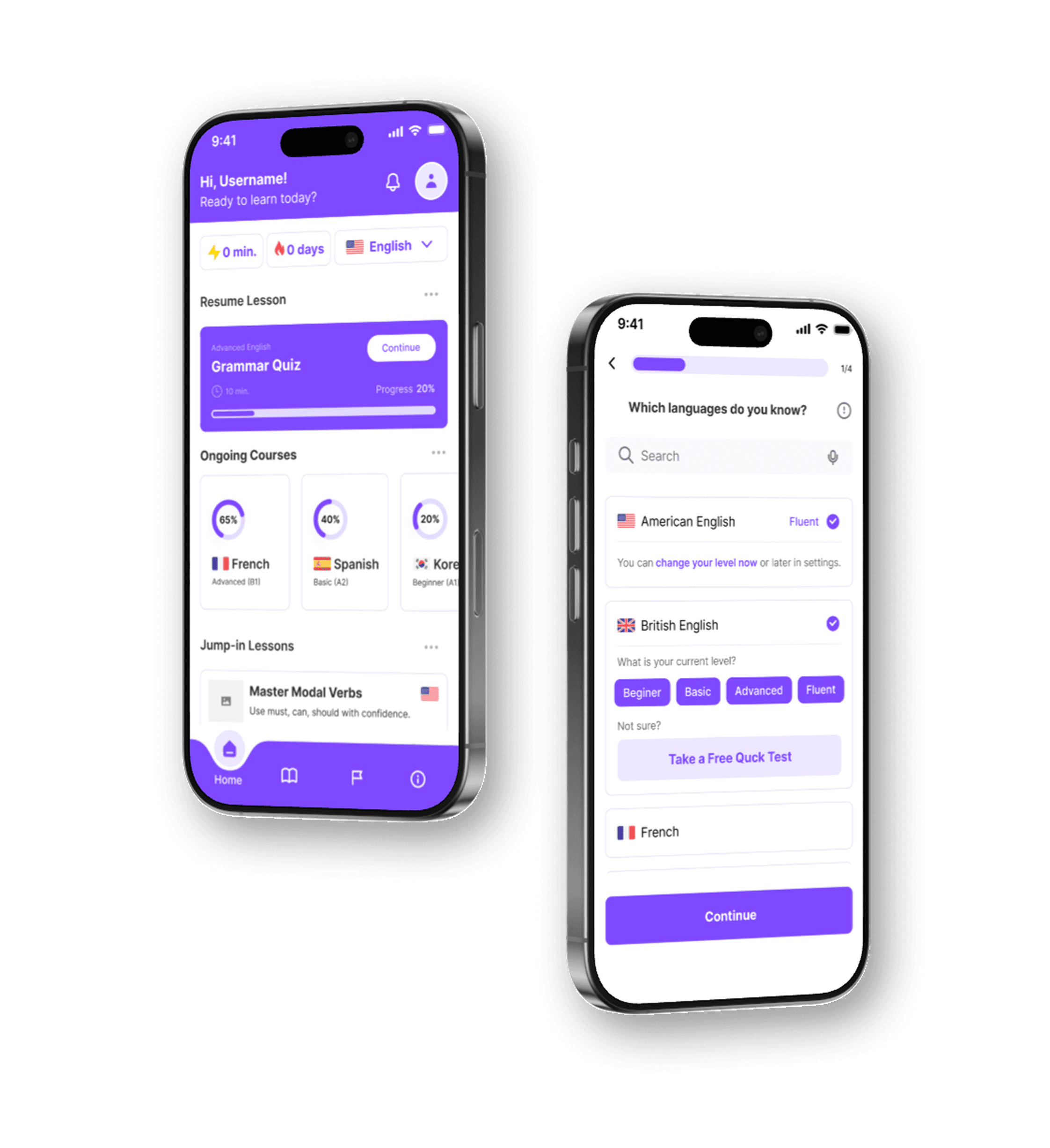
From research to screens — a concept app built for the learners the market forgot.
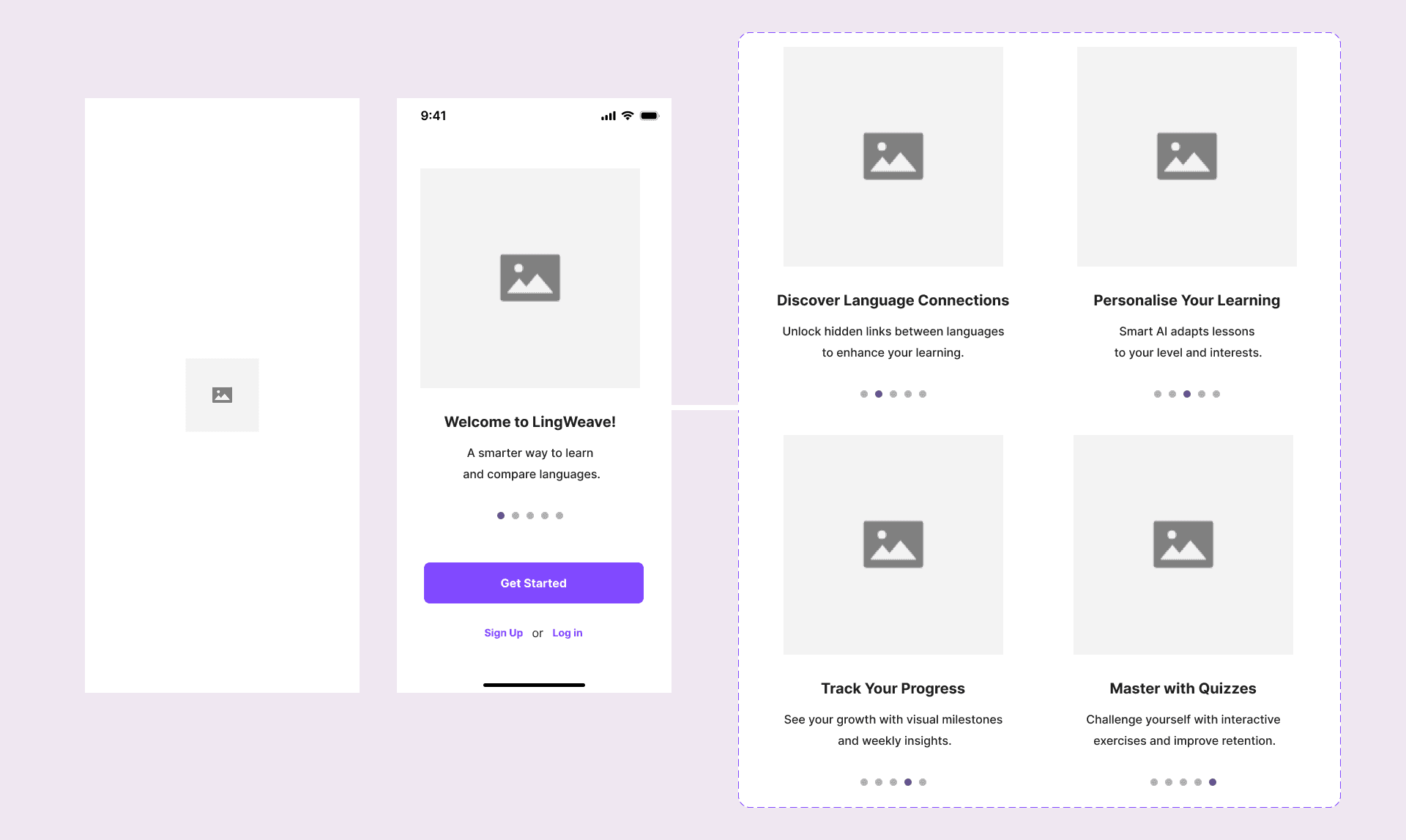
Welcome & Onboarding
The entry point sets the tone — a clean welcome screen that immediately communicates the core promise: smarter language learning for people who already know more than one language.
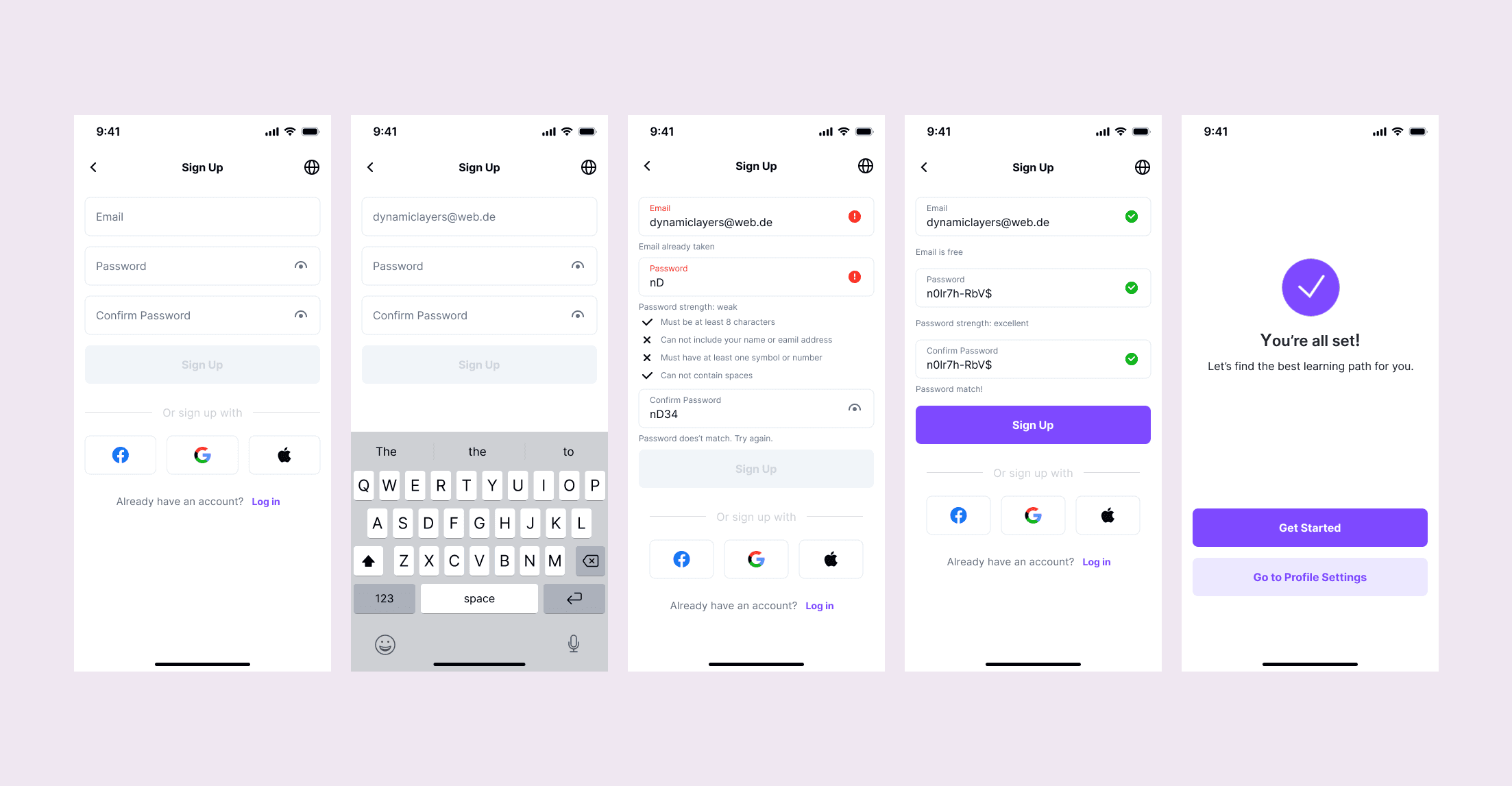
Sign Up
Registration includes live validation, real-time password strength feedback, and clear error states — so users never have to guess what went wrong. Social sign-up via Google, Facebook, and Apple reduces friction for new users.
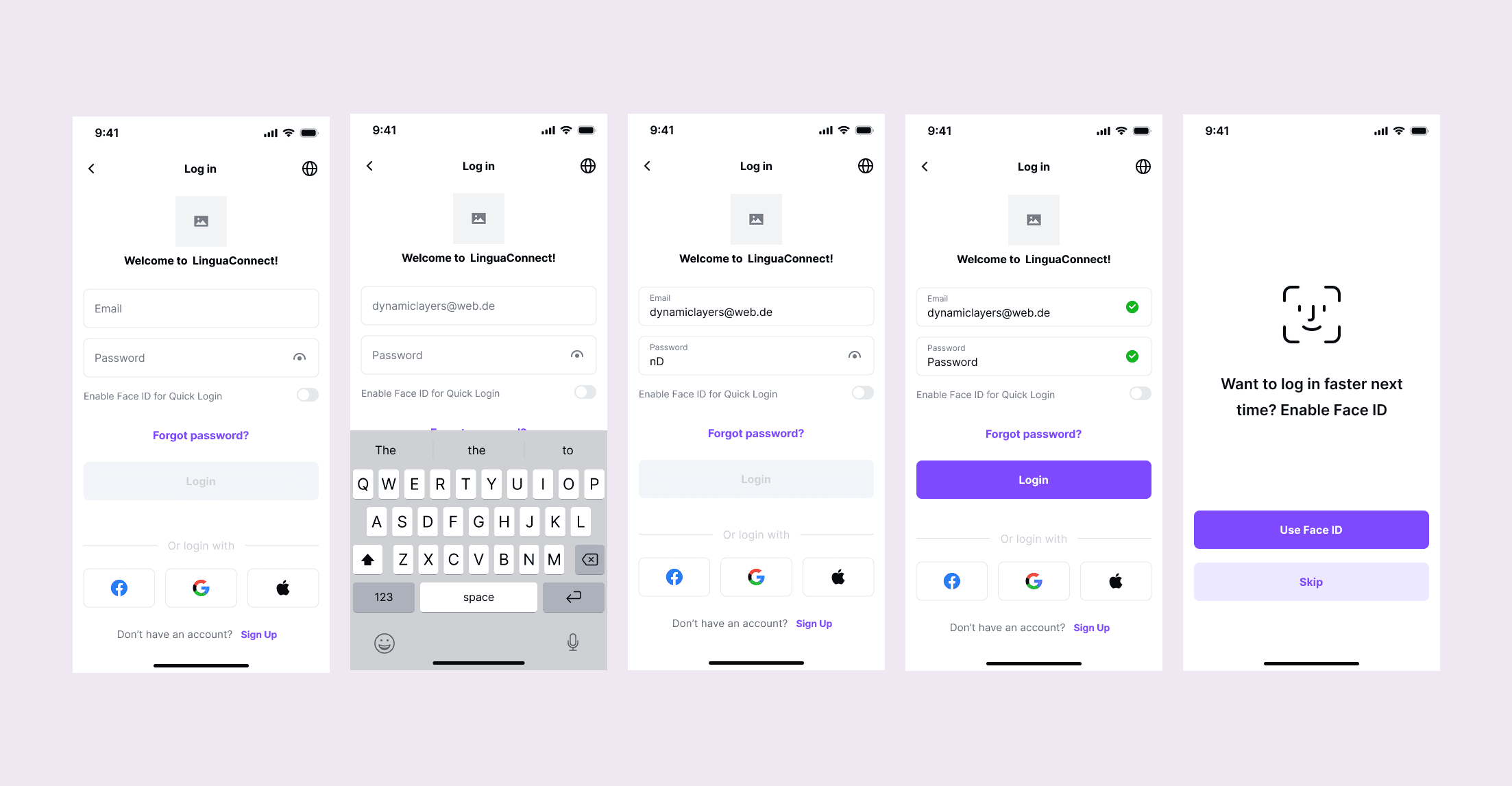
Log In
Returning users get a familiar, distraction-free login screen. Face ID is offered as an optional shortcut — never forced, always skippable.
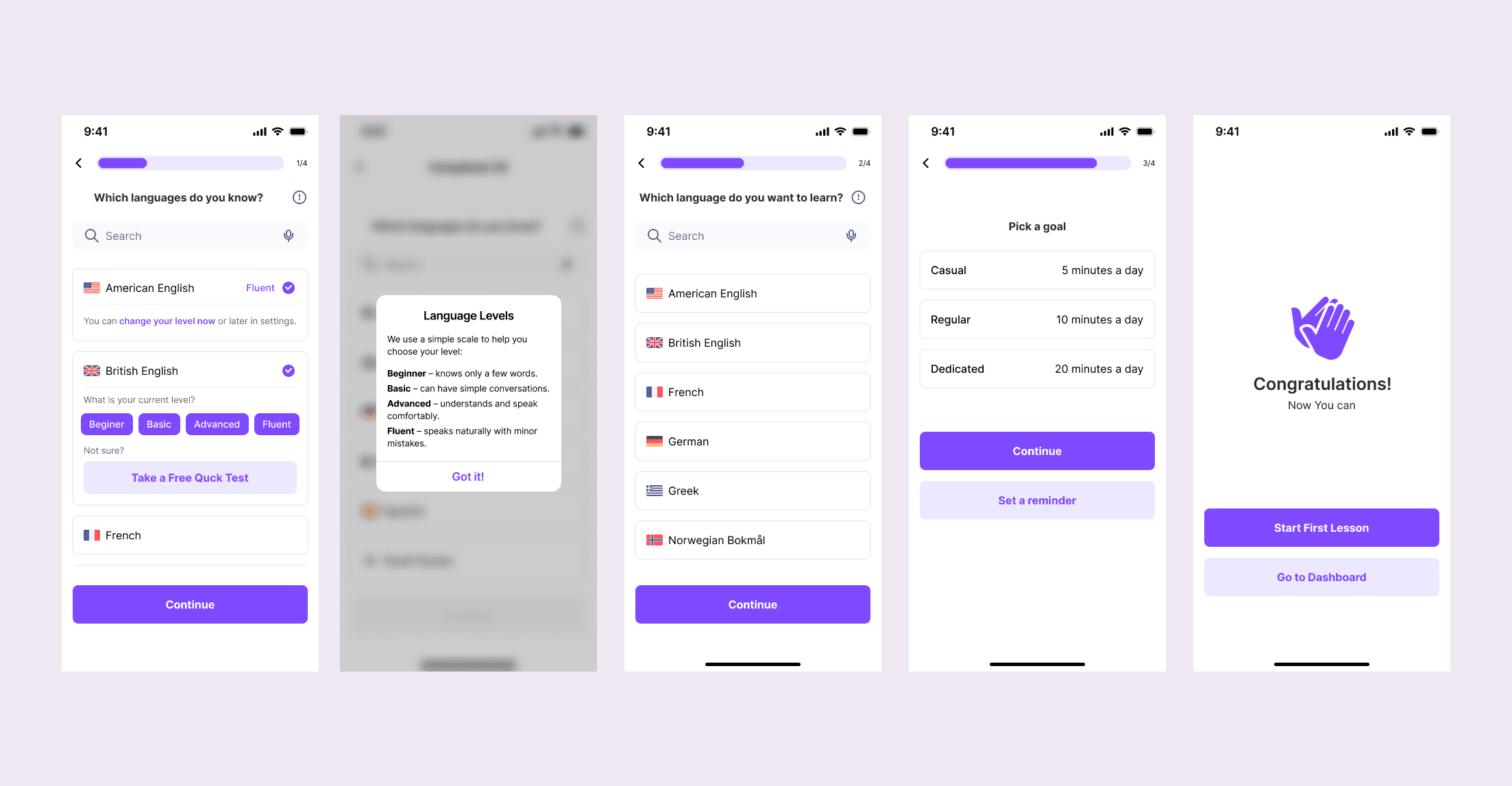
Language Setup
The heart of the onboarding. Users declare what they already know, set their proficiency level, and choose what they want to learn next. The system then filters out redundant content and builds a personalized path.
Placement Test
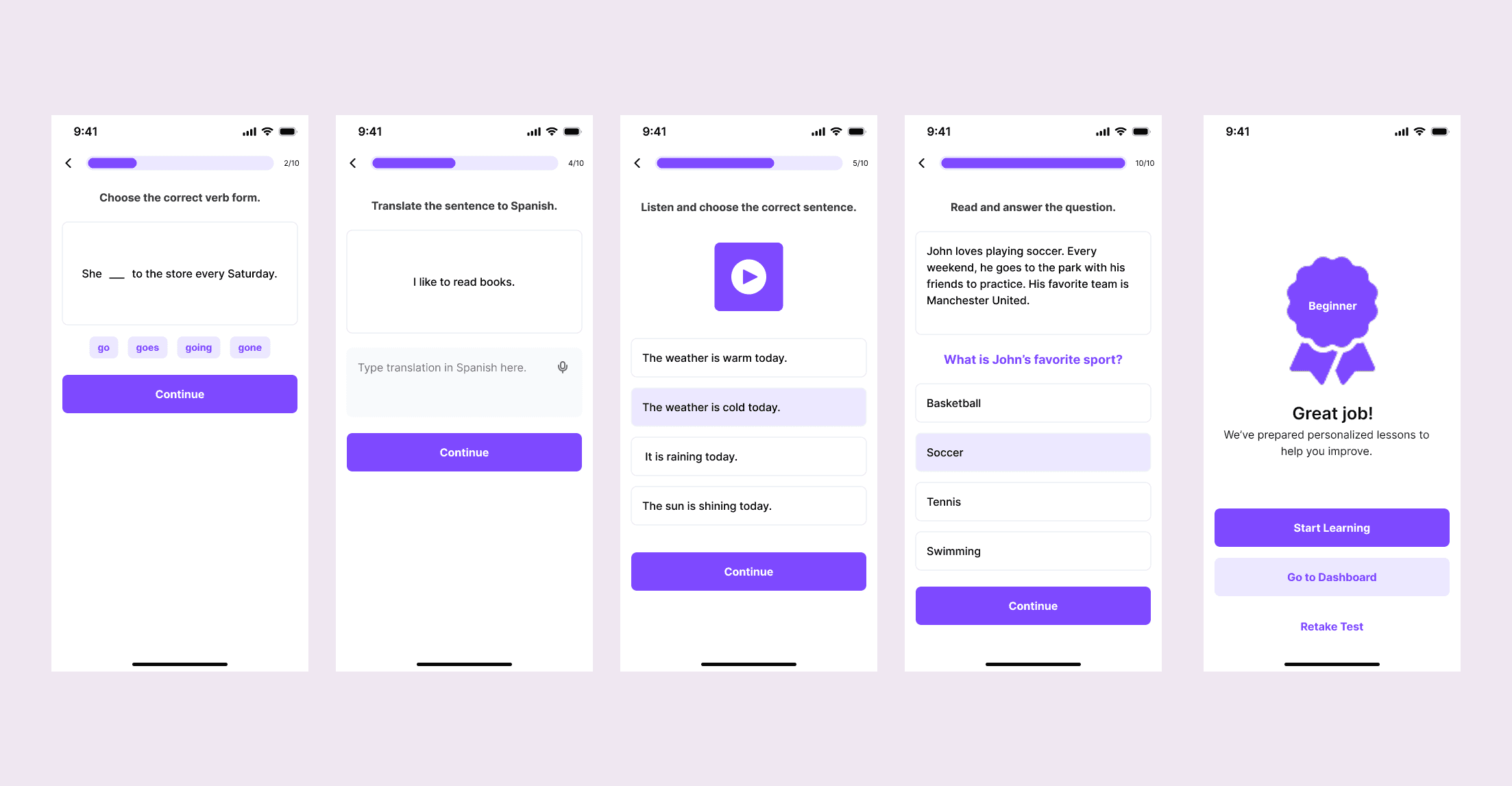
For users who aren't sure of their level — or want to verify it — a short adaptive test covers grammar, translation, listening, and reading comprehension. The result feeds directly into the recommended learning path.
Dashboard & Progress
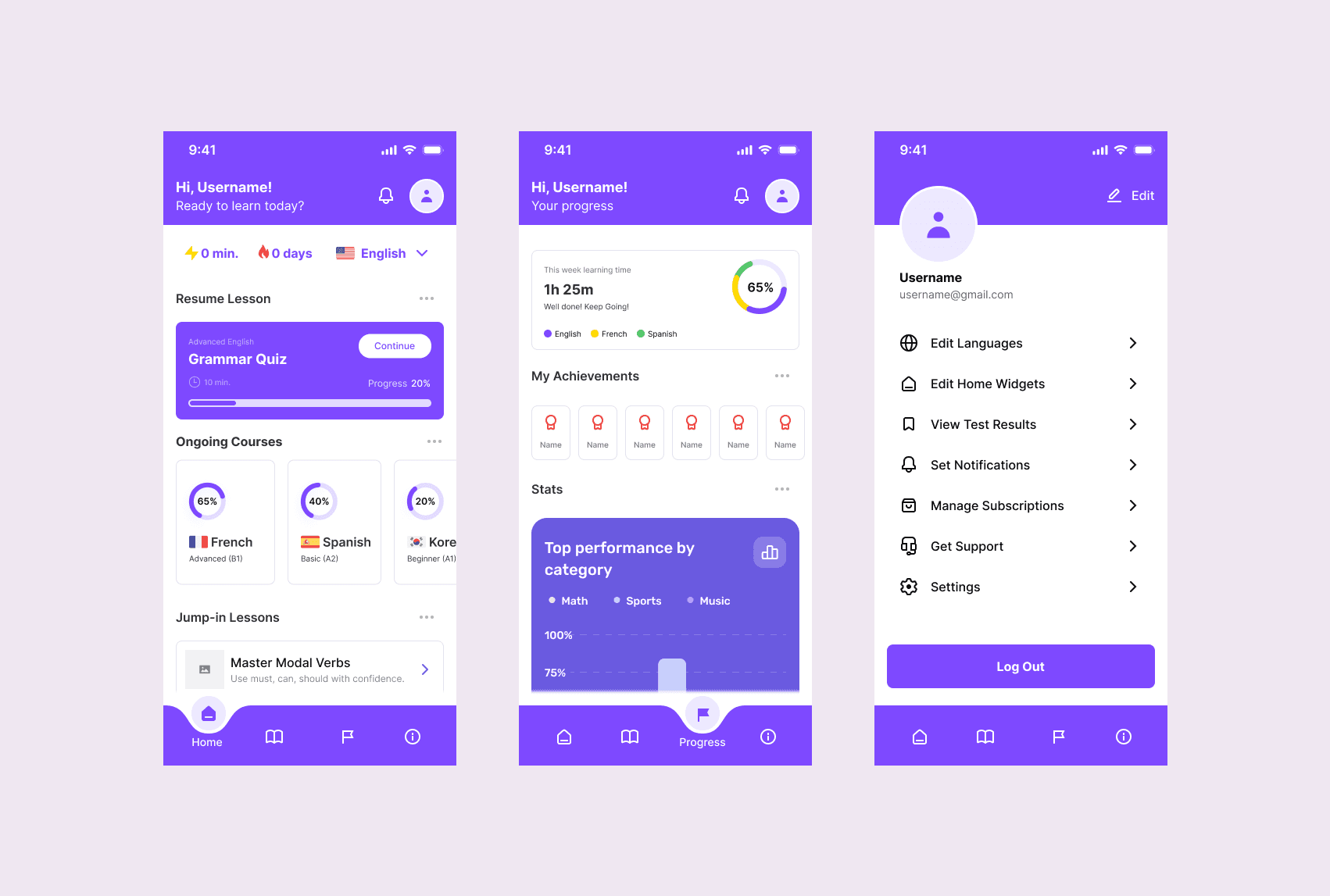
The main screen surfaces what matters most: current courses, time spent, achievements, and a quick-jump to the last lesson. Progress tracking is visual and motivating without being overwhelming.
07 Conclusion
Where This Is Going
LingWeave started as a personal frustration — every language app I tried assumed I was a beginner. It became a research project, then a concept, then a prototype.
The core flows are designed. The research is real. The problem is unsolved in the market.
This is a passion project in progress — and one I intend to finish.